Hillel and Shammai

With the Advent of the House of Hillel and the House of Shammai, the Torah Became like Two Torahs.

The House of Hillel and the House of Shammai were two schools of Jewish thought and law founded by Hillel the Elder and his contemporary, Shammai. Both schools flourished in Jerusalem under their founders and descendants beginning circa 40 BCE. Their influence encompassed the years leading up to the arrival of “Jesus the Nazarene,” the Crucifixion and Resurrection, Eleazar’s execution of members of the House of Hillel, the destruction of the Jerusalem Temple in 70 CE, and many generations beyond.[2]

The founders’ names carry clues to their divergent philosophies and interpretations of the Torah: Shammai, from shema, is the first word of a section of the Torah that opens the morning and evening prayers addressed to YHWH. Shema is translated, “hear-obey.” Shammai was an ultra-conservative Torah and Ten Commandments literalist. He was a YaH-udean, a proponent of YaHWeH, a leader of the Tribe of Judah.

Hillel, from Ha’eL eL eLa, translated, “Praise God-Goddess,” is a reference to the opening words in Genesis when Philo’s Rules[3] for interpretation are applied (we’ll examine them in a moment). Hillel was a Nasi, translated “lord” and/or “prince.” He was a liberal, progressive teacher who minimized the value of the Ten Commandments when he condensed his version of the Torah into one sentence: “What is hateful to you, do not do to your fellow: this is the whole Torah; the rest is the explanation; go and learn.”[4] Hillel was a proponent of Ba’eL and Isha Orah, translated “Father God” and “Woman Light.” Together, Isha Orah and El are IshOrahEl. Hillel was a leader of the remnants of the Tribe of Ishrael after the mass defections at Mount Carmel.[5]

Hillel taught Shammai’s precepts alongside his own; in fact, Hillel’s students recited Shammai’s first before Hillel’s.[6] However, Shammai prohibited his students from knowing anything of Hillel’s teachings. The Ten Commandments cannot be ignored or compromised!

Historically, Kings and Queens took the name of their preferred imagined deity. For example, Persian King Nabuchadnezzar was named after the god, Nabu; the King’s name means, “Nabu preserve/protect my firstborn son.” Cyrus the Great, a hero in the Old Testament,[7] was so compassionate that his subjects, who believed him to be God, called him “Father.”  

In Old Testament stories, YaHWeH, Ba’eL, eLa Ha eM and Isha Orah (also known as “Asherah”) are names of Kings and Queens who embodied imagined deities of the same name. YHWH (translated “LORD”) was imagined to be authoritative and vindictive; Father El, Ela the Mother, and Asherah were imagined to be compassionate and forgiving, like loving Parents. Notably, Jesus prayed to “Abba, Abba” (Mk 14:36) and “Ela, Ela” (Mk 15:34), a clear indication that he was a graduate of the School of Nasi Hillel.

The Old Testament deity that exhibits symptoms of a “bi-polar personality disorder” is explained by this rational interpretation of biblical texts. The stories are not about “One God” with a confusing dual nature. The stories are about the leaders of two tribes whose ruling styles were based on two different schools of thought and interpretations of Torah. The Kings’ chosen deities, and namesakes, were imagined into being by men and women who infused them with their own values, emotions, and opinions about the best way to rule.

More intriguing and impressive, “the Torah was like two Torahs” because one string of Hebrew consonants can be used to create two different sentences with entirely different meanings, one for Shammai’s Judeans, the other for Hillel’s Israelites.

For example, Genesis 1:1 opens with the consonants, BRSTBRLHM. Rendered BaReSiT BaRa eLoHiM, these words are translated, “In the beginning God created…” (Shammai’s version which was also recited by Hillel’s students before reciting the Nasi’s alternative version). Here’s the problem with this translation: the Hebrew word for “God” is Eloah; the im suffix creates the plural, “Gods.” Philo says this “artificial interpretation of a single expression”[8] is a signal to the initiated (i.e., Hillel’s students) to look for an alternative correct word. A correct rendering and translation of LHM is eLa Ha eM, “Goddess the Mother.” This may not be acceptable to Shammai, patriarchal priests, evangelical preachers, or the Pope, but it is the correct rendering and translation of LHM. (According to Strong’s Hebrew Concordance, Goddess the Mother (LHM) appears 2,598 times in the OT.)

Here’s where it gets really interesting: BRSTBRLHM can be correctly rendered BaR iS, eT aB oR, eLa Ha eM, “Son of Man, Father Light, Goddess the Mother…” (Nasi Hillel’s Nasarene translation unknown to Shammai’s students). This was the original “Holy Trinity” that was rejected by Paul and the Church Fathers. This discovery solves the mystery of the “Son of Man” sayings in the New Testament. “Son of Man” is the phrase that opens Hillel’s version of Genesis, a clue to the version taught by Jesus who repeatedly refers to himself as “Son of Man.[9] Unfortunately, the correct interpretation that Jesus preferred has been hidden from orthodox successors of the Early Church, while the protectors of His secret have been forced to hide underground.

Jesus the Nasarean said to the Twelve and the others around him, “The secret of the kingdom of God has been given to you. But to those on the outside everything is said in parables …” (aka, “enigmas”; Mk 4:11). “The Secret” is that the word erroneously translated “God” is LHM, correctly translated “Goddess the Mother.” She is rediscovered when Mark is translated back to the original Hebrew, a concept not yet embraced by resistant Markan scholars. However, compelling evidence has existed for several decades: While working on the Dead Sea Scrolls in 1963, French biblical scholar Jean Carmignac decided to translate Greek Mark to Hebrew. He was surprised to discover that the translation points to Greek Mark as a translation from a Hebrew or Aramaic original.[10]

And more evidence can be teased from the text, what’s there and what’s missing. “Mark” fails to mention that Jesus came “from Bethlehem” and was born to a “Virgin Mother.” These stunning omissions are especially problematic because most biblical scholars agree that proto-Mark was the source for Matthew’s and Luke’s gospels where Micah’s Bethlehem Prophesy (5:2-3) is fulfilled. Early Church Fathers claimed Matthew’s gospel was composed first, and in Hebrew, a claim most scholars discount today. However, they continue to defend many of the Fathers’ other claims, including that Jesus was called “The Nazarene” because “he came from Nazareth.” This, too, was an early distraction to lead the faithful away from the “Historical Jesus” and the truth about his mission.

Two New Testament verses are all that stand in the way of finding Bethlehem and the Virgin Mother in Mark’s Hebrew gospel. Once that’s done, a related prophesy in Micah and a related story in Genesis can be used to restore the lost ending: The related prophesy is Micah 4:8-10, the return of “Magdal, Daughter Jerusalem”[11]; the related story in Genesis is 40:22; 41:1-45, the crucifixion, reappearance, and demonstrated wisdom of “The Baker.”

The two New Testament interpolations that led us all astray are:

  1. Matthew 2:23: “and he went and lived in…Nazareth. So…he would be called a Nazarene.”
  2. Mark 1:9: “At that time Jesus came from Nazareth in Galilee…”

Available evidence viewed objectively suggests that Bishop Irenaeus (c. 130 to c. 200) added verse 23 to the end of Matthew, Chapter Two, then interpolated Mark 1:9 to lend support.[12] In doing so, he removed the fulfillment of the two important prophesies that would identify “The Messiah.”

Look at what happens when “Nazareth” is replaced by “Bethlehem” at Mk 1:9:

  • Hebrew BTLHM, rendered BeTLeHeM, is the “little town in Galilee,” as prophesied.
  • Hebrew BTLHM, rendered BeTuLaH eM, is translated “Virgin Mother,” as prophesied.
  • Hebrew BTLHM, rendered BaT eLa Ha eM, is translated “Daughter, Goddess the Mother.”

Both the missing prophesies are fulfilled in Mark’s gospel when “Nazareth” is removed and “BTLHM” is restored.  Furthermore, a “Daughter, Goddess the Mother” also appears. What’s that about? And, why would Bishop Irenaeus or any other Church Father falsify the reason “Jesus” was called “The Nazarene”?

The answers to these questions explain why “Jesus the Nazarene, Son of Joseph” was “born” in the first place. Mark’s Crucifixion was originally a dramatization of the story of the first crucifixion in Genesis. The victim is “The Baker” whom Pharaoh imprisoned with “Joseph the Nazar,” Israel’s “Prince,” sold into slavery by his envious step-brothers. Joseph’s mother was RKL RaKeL (oRaK + eLa = “Spirit of Ela”), and his biological father was a King whose name was Eloah.[13] This is the King El and Queen Ela praised by HaeL El and Ela, the man whose name, Hillel, is literally translated, “Praise El and Ela.”

The Baker is sentenced to be crucified; Hillel’s rendering of the climactic scene reveals that The Baker is Rachel, Joseph’s Mother.[14]  Two years later, when Pharaoh has worrisome dreams and is desperate to have them explained, Joseph, with help from LHM, interprets them and saves the people of Egypt from a great famine.[15] Obviously, The Baker, also known as eLa Ha eM, was not crucified after all.[16]

Scholars agree that the original ending of Mark’s gospel was removed, and two later attempts were made to harmonize it with Matthew and Luke.[17] Fortunately, Hillel’s interpretation of the first crucifixion in Genesis also helps reconstruct the original ending of Hebrew Mark:

In the remake played out on the streets of Jerusalem, Jesus the Nazarene volunteers to take his mother’s place on the cross; Jesus valued Her life over his own! She, then, concocts an elixir from plants and saves his life, too. “Virgin Mother” (BeTuLaH eM), “Son of God” (YaH-Zeus),[18] and “Daughter of Goddess the Mother” (BaT eLa Ha eM) emerge from the tomb victorious over death. “Daughter Jerusalem[19] returns to fulfill Micah’s ignored prophesy (4:8-10),[20] and the Son, Daughter, Goddess and God live on, generation after generation into infinity. Well, that was the plan.

Judah’s patriarchal priests objected to honoring the goddess; She might elevate the perceived value of women. Worse, women who felt valued might rebel against those who attempted to subjugate and control them. YHWH forbid!

Some Judean priests rejected the new myth outright and remained Orthodox Jews. They supported the Zealot, Eleazar ben Ananias, who invited the students of both schools to meet at his house; Eleazar, another trickster, instructed armed men to let no-one leave the meeting; several members of the House of Hillel were then killed; Eleazar’s men leverage these deaths to force the others to adopt Shammai’s rules, The Eighteen Articles. Jewish history defines the occasion as a day of misfortune.[21] Indeed! It was the opening volley that led to the destruction of the Jerusalem Temple in 70 CE.

More moderate priests were ready for the Messiah to appear, but not Daughter Jerusalem. And so, “Jesus the Scapegoat Savior of Believers” was born, setting back the recognition of the value of women another two thousand years while giving birth to Paul’s “Christianity.”

The truth underlying biblical stories does not demand that rational reasoning be replaced by faith in irrational claims, as we’ve been told. It does demand thoughtful consideration of the evidence, and a mind open to a revised history and the restoration of herstory.

“The Nasarene,” as he was known, reveals that Jesus was a descendant of “The Nasi” Hillel and inherited the position of Nasi of the Great Sanhedrin. Hillel’s grandson was Nasi Gamaliel the Elder; Gamaliel’s son was “Jesus,” also known as, “bar-Jesus.”[22]

Gamaliel VI (circa 370 to 425) was the last Nasi of the Great Sanhedrin, ascending to that position circa 400. On October 20, 415, Emperors Honorius and Theodosius II issued an edict that stripped Gamaliel of his rank of Honorary Prefect. It banned him from building synagogues, deciding disputes between Jews and Christians, converting non-Jews to Judaism, and owning Christian slaves. [23]

Gamaliel was probably executed in 425, the year before an edict transformed the patriarch’s tax into an imperial tax. Theodosius refused to allow the appointment of a successor and in 429 terminated the Jewish patriarchate.[24]

This is just the beginning of the secrets Hillel’s Method of interpretation reveals. Philo of Alexandria preserved, simplified, and enumerated it on behalf of the man rejected by Paul and the Early Church Fathers, “Jesus the Nasarene.”

PaxAmoLux!

Copyright PJ Gott, 2019, Springfield, Missouri


[1] Mishnah: Hagigah (Tosefta) 2:9; Sanhedrin 88b; Sotah 47b. Also, “House of Hillel,” Wikipedia footnote, Drew Kaplan, “Rabbinic Popularity in the Mishnah VII: Top Ten Overall (Final Tally), Drew Kaplan’s Blog (5 July 2011).” Wikipedia: https://en.wikipedia.org/wiki/House_of_Hillel. “Hillel and Shammai,” https://www.jewishvirtuallibrary.org/hillel-and-shammai.

[2] “Hillel and Shammai,” Wikipedia: https://en.wikipedia.org/wiki/Hillel_and_Shammai

[3] Philo of Alexandria, a contemporary of Jesus and Mary Magdalene, wrote 21 rules for identifying “enigmas” in scripture.

[4] “Hillel the Elder,” Wikipedia: https://en.wikipedia.org/wiki/Hillel_the_Elder. Shabbat 31a.

[5] 1 Kings 18:36-40: Elijah the trickster tossed a water-combustible chemical on water to prove YHWH was more powerful than Father El and Asherah. The majority of the Israelites abandoned their deities in favor of YHWH.

[6] “Beit Hillel,” Wikipedia: https://en.wikipedia.org/wiki/House_of_Hillel.

[7] 2 Chronicles 36:22; Ezra 1:1-8; Ezra 3; Ezra 4:3-5; Isaiah 44-5; Daniel 1:21; 10:1.

[8] Philo’s Rule No. 16 for identifying and “enigma.”

[9] The term, Son of man, is used by Jesus 80 times as a way to refer to himself (32 times in Matthew; 14 times in Mark; 26 times in Luke; and 10 times in a qualitatively different way from the Synoptic Gospels in John).

[10] Jean Carmignac, The Birth of the Synoptics (Chicago: Franciscan Herald Press (1987), p. 1.

[11]And you, Magdal eder…to you shall come the kingdom of Daughter Jerusalem…”

[12] Irenaeus “Against Heresies,” Alexander Roberts, ed., The Gnostic Society Library Online (1995), 1.9.4-5, n.p.

[13] Gen 30:22: Philo says, “Examine the Hebrew words and select a valid alternative for eLeHa, translated ‘to her.’” eLeHa can also be rendered eLoaH, which is Hebrew for “God.” The reason Joseph was the only “prince” among Jacob’s twelve sons is because his biological father was King Eloah, whose name ties him to the deities, Eloah and Ela Ha Em.

[14] Gen 40:22.

[15] Gen 41:1-45.

[16] Hillel’s version describes how the ancient Hebrew Goddess Shabbat convinced Pharaoh to change his mind about crucifying The Baker, the embodiment of Ela Ha Em.

[17] Both are often added to Mark with footnotes, “the shorter ending”; “the longer ending.”

[18] YHWH + Zeus = YaH-Zeus, invented to peacefully unite Orthodox Jews and Romans.

[19] Jerusalem can be rendered YaRa iSha eLa eM, “Teacher, Woman, Goddess Mother.”

[20] “And you, Magdal eder…to you shall come the kingdom of Daughter Jerusalem…”

[21] Shabbat (Tosefta) 1:16+;  Shabbat 13a;  Shabbat 17a; Shabbat (Jerusalem Talmud) 1:3c. “Bet Hillell and Bet Shammai: Relation to External World.” Marcus Jastrow and S. Mendelsohn, Jewish Encyclopedia online: http://www.jewishencyclopedia.com/articles/3190-bet-hillel-and-bet-shammai.

[22] Josephus, 1999, Antiquities 20.9.4 (213-214), 657. Luke 13:5-11.

[23] Graetz, Heinrich, History of the Jews. (Philadelphia: Jewish Publication Society, 1898).

[24] Pharr, Clyde (1952). The Theodosian Code and Novels and the Sirmondian Constitutions. (Princeton: Princeton University Press, 1952) 470-1. “Rabban Gamaliel VI,” Wikipedia: https://en.wikipedia.org/wiki/Raban_Gamaliel_VI

The Secret of the Kingdom of LHM

Mother of the Man Called “Jesus” in Mark’s Gospel

Antonia Minor

Image Downloaded from: https://en.wikipedia.org/wiki/File:Antonia_minor_pushkin.jpg

To the Twelve and the others around him, Jesus said, “The secret of the kingdom of LHM has been given to you. But to those on the outside everything is said in enigmas…”  (Mk 4:11).

What was “The Secret”? It’s found when Mark is translated back to the original Hebrew.[1]

In the Old Testament LHM is translated 2,598 times as “God.” THIS IS INCORRECT. The im suffix creates the plural of eLoaH, the correct word for “God.” Considering the context of the stories, the only correct rendering of LHM is eLa Ha eM, “Goddess the Mother.” That was “The Secret” known to the people closest to Jesus, and it was the secret they set about to share with new converts. No longer would Judah and Israel be missing their ancient goddess destroyed over and over again by misogynistic Kings. Jesus the Messiah returned, and he brought Her with him.

Furthermore, Jesus volunteered to sacrifice his life when hers was threatened! In other words, Jesus valued his mother’s life over his own! That was the original ending of the Myth of Jesus the Nazarene in Mark’s gospel.

Two New Testament verses are all that stand in the way of this Christianity-shattering revelation:

Matthew 2:23: “and he went and lived in a town called Nazareth. So…he would be called a Nazarene.”

Mark 1:9: “At that time Jesus came from Nazareth in Galilee…”

Scholars have always expressed concern that “Mark” seems unaware that Jesus came “from Bethlehem” and was born to a “Virgin Mother.” These oversights are especially problematic because most agree that proto-Mark was the source for Matthew’s and Luke’s gospels. However, trusted Early Church Fathers claimed Matthew’s gospel was composed first in Hebrew, an attempt to cover the fact that Mark was first and it was composed in Hebrew.[1]

Evidence suggests that Bishop Irenaeus (c. 130 to c. 200) added verse 23 to the end of Matthew, Chapter Two, then interpolated Mark’s to lend support. In doing so, he removed the fulfillment of the two important prophesies that would identify “The Messiah.”

Look at what happens when “Nazareth” is replaced by “Bethlehem”:

BTLHM, rendered BeTLeHeM, is a “little town in Galilee.”

BTLHM, rendered BeTuLaH eM, is translated “Virgin Mother.”

BTLHM, rendered BaT eLa Ha eM, is translated “Daughter of Goddess the Mother.”

Both the missing prophesies are fulfilled in Mark’s gospel when “Nazareth” is removed and “Bethlehem” is restored.

Why would Irenaeus or any other Church Father falsify the reason “Jesus” was called “The Nazarene”?

It’s the reason “Jesus the Nazarene” was invented in the first place. The story of the first crucifixion in the Old Testament is about a “Baker” whom Pharaoh imprisoned with “Joseph the Nazar” (Israel’s “Prince” who was sold into slavery).  Joseph’s mother was Rachel and his biological father was King Eloah.[2] The Baker is sentenced to be crucified. The Essene-Nazarene rendering of the climactic scene reveals that “The Baker” is Rachel, Joseph’s Mother. Two years later, when Pharaoh is disturbed by dreams, Joseph, with help from LHM, interprets them and saves the people of Egypt from a great famine. Obviously, something happened and Rachel the Baker, also known as eLa Ha eM, was not crucified.

Scholars agree that the original ending of Mark’s gospel was removed and at least two attempts made to harmonize it with Orthodoxy. However, the story of the first crucifixion in Genesis helps reconstruct the original ending of Hebrew Mark.

“Jesus the Nazarene, Son of Joseph” was an updated version of the story of “Joseph the Nazar, Son of Rachel,” aka, “Goddess the Mother.” Jesus son of Goddess volunteered to take her place on the cross so that she could live. She, then, concocted an elixir from plants that saved his life, too. Mother (LHM), Son (YH-Zeus), and Daughter of Goddess the Mother (Bat Ela Ha Em) emerged from the tomb victorious over death. The Goddess returns, and the Son and Daughter of God and Goddess live on, elevating the status of women.

Judah’s patriarchal priests objected. Many rejected the new myth outright and remained Orthodox Jews; however, some were open to an alternative version of the return of the Messiah. And so “Jesus the Scapegoat Savior of Believers” was born, setting back the recognition of the value of women another two thousand years.

COPYRIGHT 2019, P.J. GOTT, SPRINGFIELD, MO

Footnotes:

[1] In 1963 while working on the Dead Sea Scrolls, the French biblical scholar Jean Carmignac decided to translate Greek Mark to Hebrew. He was surprised to discover that the translation seemed to point to Greek Mark as a translation from a Hebrew or Aramaic original. ( Carmignac, Jean (1987). The Birth of the Synoptics. Chicago: Franciscan Herald Press. p. 1. ISBN 9780819908872.

[2] Gen 30:22: Philo says, examine the Hebrew words and select a valid alternative for eLeHa, translated “to her.” eLeHa can also be rendered eLoaH, which is Hebrew for “God.” The reason Joseph was the only “prince” of Jacob’s twelve sons is because his biological father was King Eloah.

The Baker’s Tomb


BAKER’S TOMB, ROME, ITALY
JUNE 15, 2015
Photograph by P.J. Gott

When I first saw the Baker’s Tomb in June 2015,  it was surrounded by weeds. It sits just outside Rome’s East Gate, the Porta Maggiore, which features a “wide” and a “narrow” gate, the inspiration for Mt 7:13-14. It was built c. 52 when Claudius was Emperor.

Contrary to tradition, the Baker’s Tomb was not built in the first century BCE; it was built c. 74 CE when the two people most important to the Story of Jesus the Nazarene and Mary the Magdalene died within a short time of one another. Their remains were placed in the Tomb, which became the focus of Essene-Nazarene ceremonies for more than three hundred years.

Then, circa 400 CE, Bishop Epiphanius convinced Emperors Theodosius and his son Honorius to put an end to the Nazarene “Heresy” for all time. They buried the Baker’s Tomb and the Porta Maggiore beneath a monstrous structure and destroyed all other “heretical” monuments and temples throughout the Roman Empire.

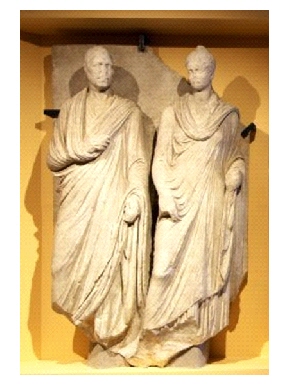
A heavily damaged marble relief of the couple entombed was retrieved in 1838 when Pope Gregory the XVI had the Tomb and the Porta Maggiore uncovered, concurrent with an apostolic letter forbidding “Faithful Catholics” to participate in the Atlantic Slave Trade.

Hidden for more than two centuries in the bowels of the Capitoline Museum, the marble relief was recently restored and put on display at one of Rome’s least-visited museums, Centrale Montemartini. A former industrial power plant, this obscure museum houses over 400 pieces of ancient sculpture from the collection of the Capitoline Museums. At one time, the woman’s head was missing in photographs. This “Freedman” and “Freedwoman” were dressed much like royalty of the time. 

Marble Relief Antistia and Eurysacis

In fact, the image of the Baker and her husband (above) is very similar to one of Emperor Tiberius and Empress Livia (below). (Tiberius was the father of the man who played the role of “Jesus the Nazarene.”)

An epitaph found with the relief portrait of the Baker and her husband is written in Latin and honors the woman:

FVIT ATISTIA VXOR MIHEI
Atistia was my wife

FEMINA OPITVMA VEIXSIT
A most excellent lady in life

QVOIVS CORPORIS RELIQVIAE
the surviving remains of her body

QUOD SVPERANT SVNT IN
which are in

HOC PANARIO

this breadbasket

Writing in the Greek language, Philo of Alexandria, a contemporary of “JC and MM,” overused the phrase, “most excellent,” to the extreme, in writings still extant. It is also prominent in the opening verses of Luke and Acts. I note this because “Atistia the Freedwoman” was also known as the “Freedman Antonius Pallas,” the “Freedwoman Antonia Caenis,” “Philo of Alexandria,” “Mary Magdalene,” et. al. Evidence for this stunning claim is outlined in mind-numbing detail in the three volumes of Following Philo, available from Amazon (link below).

The Tomb itself is rife with clues to the identities of the couple. Look closely at the three times the letter “T” appears. They are noticeably larger than the other letters and appear be crosses in the style of first century Roman crucifixions.

The Latin words, repeated on the three sides of the Tomb that remain intact are, MARCEI VERGILEI EURYSACIS PISTORIS REDEMPTORIS APPARET, traditionally translated, incorrectly, “This is the monument of Marcus Vergilius Eurysacis, baker, contractor, public servant.”

However, this common translation is problematic and deficient for several reasons: The most obvious problem is with the last word, APPARET. Translated here as a noun (“public servant”), apparet is a verb that means “to come in sight, to appear, become visible, make one’s appearance (class. in prose and poetry).” Also, “to be seen, to show one’s self, be in public, appear.” Therefore, it is quite clear that “public servant” is not the correct translation.

MARCEI is a reference to the god Mars, the father of twin sons, Romulus and Remus, the mythological founders of Rome. The twins’ mother, Rhea Silvia, was a Vestal Virgin. In one version of the myth, the twins were conceived when Mars visited Rhea Silvia in a sacred laurel grove that was dedicated to him. It may also refer to Marc Antony’s daughter Antonia, the mother of the woman who played the role of “Mary Magdalene.”

VERGILEI is a reference to Vestal Virgins, the preeminent “Bakers” in the Roman Empire. Vestals led the annual New Year rites on March 1 when new laurel branches replaced the old branches as they relit the sacred fire to symbolize a fresh start of the New Year. The poet “Vergil,” a “Vestal Virgin,” was the grandmother of the woman called “Mary Magdalene.”

The Vestals’ most important festival was the annual Vestalia which ran from June 7 to June 15. On June 9, according to first century poet Ovid, also a Julio-Claudian, a donkey was crowned with garlands of flowers and bits of bread. The donkey was the animal consecrated to Vesta; it was also the animal that delivered the “Bat Ela Ha Em, the Betulah em,  to Bet Lehem” (translated, “Daughter of Ela the Mother, the Virgin Mother, to Bethlehem”). A donkey also delivered Jesus to “Daughter Jerusalem” prior to the Crucifixion.

EURYSACIS can be broken into two words: Eury means “wide”; sacis means “narrow.” Rome’s East Gate, like Jerusalem’s East Gate, had a wide gate and a narrow gate. “Enter through the narrow gate. For wide is the gate and broad is the way that leads to destruction, and many enter through it” (Mt 7:13-4). The message is that a Princess of Peace passing through the narrow gate is more effective than soldiers, horses, and chariots storming through the wide gate.

PISTORIS takes us back to Ovid. Included in the definition of PISTORIS is one revealed by him: “A surname of Jupiter, because, when the Romans were besieged in the Capitol, he gave them the idea of hurling bread, as though they had an abundance of it, at the besieging Gauls.” “Jupiter,” of course, was the Roman name for the deity the Greeks called “Zeus”–as in YaH-Zeus. Therefore, if Jupiter’s surname was Pistoris, then Zeus’ and YaH-Zeus’ surnames were Pistoris as well.

REDEMPTORIS can also be tied to Mary Magdalene: the Hebrew words, MGDL DR (MiGDoL eDeR), are translated, “watchtower of the flock.” The MaGDaL was introduced in the Old Testament immediately before the Bethlehem Prophecy (Mic 5:2-3) at Mic 4:8: “As for you, watchtower of the flock, stronghold of Daughter Zion, the former dominion will be restored to you; the Kingdom will come to Daughter Jerusalem.”

Can this be interpreted as anything other than a prophecy that Daughter Jerusalem–the Watchtower of the Flock–would be resurrected from the ashes of Asherah that YHWH demanded be destroyed: “Break down their altars, smash their sacred stones and burn their Asherah poles in the fire; cut down the idols of their gods and wipe out their names from those places” (Dt 12:3).

Micah’s prophecy continues: “Writhe in agony, Daughter Zion, like a woman in labor, for now you must leave the city to camp in the open field. You will go to Babylon [where the Old Testament was compiled and edited]; there you will be delivered, Redemptoris from the hand of YHWH, your adversary” (Micah 4:9-10).

The Julio-Claudian Dynasty honored the Essene-Nazarene version of Gen 1:1: “Son of Man, Father Light, Ela the Mother.” They were fully aware that the “Gods and Goddesses” in Hebrew Scripture were, in fact, mortal Kings and Queens who assumed the name of their imagined deity. They understood that myths had always been attached to mortal members of royal families in order to engender awe and compliance among their subjects. They reenacted the story of the “Baker,” Joseph’s mother whom he saved from crucifixion by taking her place on the Cross. These annual celebrations were a thorn in the side of Paul and the Early Church Fathers.

The patriarchal, misogynistic Church Fathers chose the Judean version of the Hebrew Bible. They took the mythological story of “YaH-Zeus,” the “Watchtower of the Flock,” and the “Daughter of Ela the Mother,” buried the Goddess, separated “Jesus” from the Nazarenes, and turned YaH-Zeus into a historical, magical “Father, Son, and Holy Spirit,” and a vicarious atonement!!

And this irrational deception has been successfully sold, swallowed, and regurgitated for more than two thousand years!


COPYRIGHT 2019, P.J. GOTT, SPRINGFIELD, MO

Additional interpretations of enigmatic messages on the Baker’s Tomb are outlined in depth in Chapter One of Following Philo: From Ba’al and Asherah to Jesus and Mary Magdalene.

Images of Antistia and Eurysaces downloaded from https://www.wantedinrome.com/news/rome-restores-funerary-relief-of-eurysaces-the-baker.html

Image of Tiberius and Livia on the Ara Pacis downloaded from https://i.pinimg.com/originals/01/25/de/0125decb7e0d30a1f9301a3872efd849.jpg

Philo’s Rules

Philo’s 21 Rules for Identifying and interpreting Enigmas

  1. The doubling of a phrase.

  2. An apparently superfluous expression in the text.

  3. The repetition of statements previously made.

  4. A change of phraseology – all these phenomena point to something special that the reader must consider.

  5. An entirely different meaning may also be found by disregarding the ordinarily accepted division of the sentence into phrases and clauses and by considering a different combination of the words.

  6. Synonyms [and phonetically similar words] must be carefully studied.

  7. A play upon words must be utilized for finding a deeper meaning.

  8. A definite, allegorical [enigmatical] sense may be gathered from certain particles, adverbs, prepositions, [unclear pronoun antecedents], etc., and in certain cases it can be gathered even from …

  9. the part of a word.

  10. Every word must be explained in all its meanings in order that different interpretations may be found.

  11. The skillful interpreter may make slight changes in a word, following the rabbinical rule: “Read not so, but so.” Philo, therefore, changed accents, breathings, etc., in Greek [and Hebrew] words.[1]

  12. Any peculiarity in a phrase justifies the assumption that some special meaning is intended. Details regarding the form of words are very important.

  13. Consider the number of the word, if it shows any peculiarity in the singular or the plural: the tense of the verb, etc.

  14. The gender of the noun may carry a clue.

  15. Note the presence or omission of the article;

  16. the artificial interpretation of a single expression;

  17. the position of the verses of a passage; [the position of words in a phrase relative to one another];

  18. peculiar verse combinations;

  19. noteworthy omissions;

  20. striking statements [i.e., angel, spirit, Holy Spirit, omen, prophecy, etc.];

  21. numeral symbolism [i.e., Platonic; Gematria].[2]

Some of these rules act primarily as yellow flags to signal an approaching enigmatic section of text that will require a stop, some thought, and possibly some research. The words most frequently employed are angel, spirit, and prophecy.

Other rules act as red flags, which are the solution or a part of the solution to the puzzle. For example, phrases that are repeated will contain a key word or words that are exactly the same. However, most of Philo’s Rules can serve both yellow-flag and red-flag functions.

[1] The assumption that Philo worked only with the Greek Septuagint is incorrect.

[2] Jewish Encyclopedia Online(1906), “Philo Judaeus,” n.p.Following Philo to:

The Virgin Mother

Biblical Hebrew is written in consonants only, no vowels, spaces, or punctuation. This provides multiple options for each string of consonants; scribes with competing agendas choose vowels, spaces, and punctuation that best support the preconceived beliefs they want to sell. For example:

Gen 1:1 opens with this string of consonants: BRSTBRLHM… rendered BaReSiT BaRa eLoHiM…, and translated, “In the beginning created God…”

Philo’s Rule 16 for identifying “enigmas”: “Note…the artificial interpretation of a single expression…” Interpreting eLoHiM as “God” is incorrect; in other words, “artificial.” The im suffix creates the plural of eLoaH, the correct Hebrew word for “God.” The consonants LHM create “Gods,” plural.

However, LHM can be correctly rendered LeHeM, “bread,” AND LHM can be correctly rendered eLa Ha eM, “Goddess the Mother” AND “Gods.” But!!! LHM can never be translated “God.” The key to the correct choice is the context or clues dropped nearby.

At Gen 35:9-11, Jacob has a life-changing meeting with LHM (bread? Gods? or Goddess the Mother?) who advises him, “‘Your name is YaaQoB; no longer shall you be called YaaQoB, but Israel shall be your name.’ So he was called Israel. LHM also said to him, ‘I am eL ShaDDaY; be fruitful and multiply; a nation and a company of nations shall come from you, and kings shall come forth from you” (Gen 35:9-11).

LHM has now given a clue to the correct rendering of LHM. LHM says, “I am El ShaDDaY…” The Hebrew word shad is translated “breast.” Later, at Gen 49:25, El Shadday reappears as Jacob lies on his deathbed and blesses his son with Rachel, Joseph: “From eLoaH of your father who helps you, and by Shadday who blesses you with blessings of heaven above, blessings of the deep that lies beneath, blessings of the breasts and the womb.”

Now, this isn’t the first time El Shadday gave a new name to an important biblical character. She had also renamed Ab-ram (translated “Father exalted”); his new name Ab RaHaM means “Father Compassion” (Gen 17:5). And She renamed Sarai (translated “princess”); her new name iSa oRaH means “Woman Light” (Gen 17:15). ISha+oRah+eL is Ishorahel, the etymology of “Israel,” Jacob’s new name and the name of his Tribe, destined to be Kings and Queens.

Gen 35:15: “Jacob named the town where LHM spoke with him BeTeL.” BeT eL is “House of EL.” Adding BT to LHM takes us to BTLHM, the string of Hebrew consonants that create the name of the “little town” from which Jesus came, BeTLeHeM. Next we look for the origin of BeTLeHeM.

Gen 35:19: “So Rachel died, and she was buried on the way to Ephrath (that is BTLHM), and Jacob set up a pillar at her grave, it is the pillar of Rachel’s tomb…Israel journeyed on, and pitched his tent beyond the Migdol Eder (translated, “Watchtower of the Flock”).” Notably, only after Rachel dies is “Jacob” called “Israel.” Why?

The name “Rachel” is derived from Orak Ela, “Spirit of El and/or Ela.” Rachel was also the Spirit of Woman Light (Isha Orah). As long as she lived, Rachel was the Queen of Israel. Upon her death, Jacob assumed the role of King of Israel.

“Pillars” are prominent in Jacob’s story: “Jacob…took the stone that he had put under his head and set it up for a pillar…Jacob made a vow, saying, ‘If LHM will be with me, and will keep me in the Way that I go, and will give me bread to eat … so that I come again to my father’s house in peace, then YHWH shall [not] be bread, and this stone, which I have set up for a pillar, shall be LHM’s house…” (Gen 28:18-22).

Note 1: The Hebrew word translated “The Way” is DRK; rendered aDa OraK, it means “adorned Spirit” and refers to Orak eL, Rachel.

Note 2: The Hebrew consonant L can be rendered eL (“to”), aL (“not”), and/or Li (“my”). It appears in the verses quoted above following YHWH. Judean scribes chose iL (“my”), but Isha Orah’s scribes chose aL (“not”). So, Jacob rejects YHWH in favor of LHM, the Father-Mother God and Goddess, Eloah and Ela Ha Em.

BeTLeHeM did not exist until Rachel died giving birth to her second son whom she named “son of my sorrow.”

BTLHM can also be rendered BeTuLaH eM, “Virgin Mother.” Rachel was a virgin until King Eloah appeared: “Then LHM remembered Rachel, and Eloah heard and opened her womb. She conceived and bore a son…” (Gen 30:22). Rachel gave birth to “Joseph the Nazar.”

Equally important, BTLHM can be rendered BaT eLa Ha eM, translated “Daughter of Goddess the Mother.” Goddess the Mother appears in the very first scene in the Old Testament.

“Goddess” was not a superhuman being. She was the imagined perfect woman with feminine traits: Compassion, Wisdom, Nurturing Love. She was a modifying balance to support and enhance “God’s” ideal masculine traits: Physical Strength, Forcefulness, Aggression. Israelite Kings and Queens, representatives of the balanced Ideal, were called

“Father El” and “Ela the Mother.”

In Old Testament myths, “YaHWeH’s” patriarchal, misogynistic YaHudean Kings waged an ongoing war against Israel’s Kings and Queens. Without the modifying balance of a “Goddess-Queen,” King YaHWeH’s strength, forcefulness, and aggression erupted in acts of violence against children, women and men.

COPYRIGHT 2019, P.J. GOTT, SPRINGFIELD, MO

Following Philo to:

Kings and Queens of Judah and Israel

Legacy of the First Christian Heretic

Pythagoras: Architect of the Old Testament

The Baker’s Tomb

The Virgin Mother

The Secret of the Kingdom of LHM

Philo’s 21 Rules for Identifying and Interpreting Enigmas

The Baker’s Tomb, Rome, Italy, Constructed circa 74 CE

The journey that leads to the historical “Jesus and Mary Magdalene” begins at Genesis Chapter 40. Joseph the Nazar, princely son of Rachel and Jacob, also known as “Israel,” is sold into slavery in Egypt where he oversees the first crucifixion. Rarely noted is the fact that the first person in the Bible to be crucified is “The Baker.” Philo’s Rules identify enigmas that reveal a great secret: “The Baker” was Rachel, whose name is translated “Spirit of God” and/or “Spirit of Goddess.”

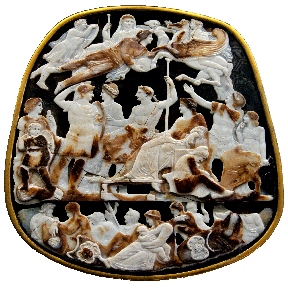
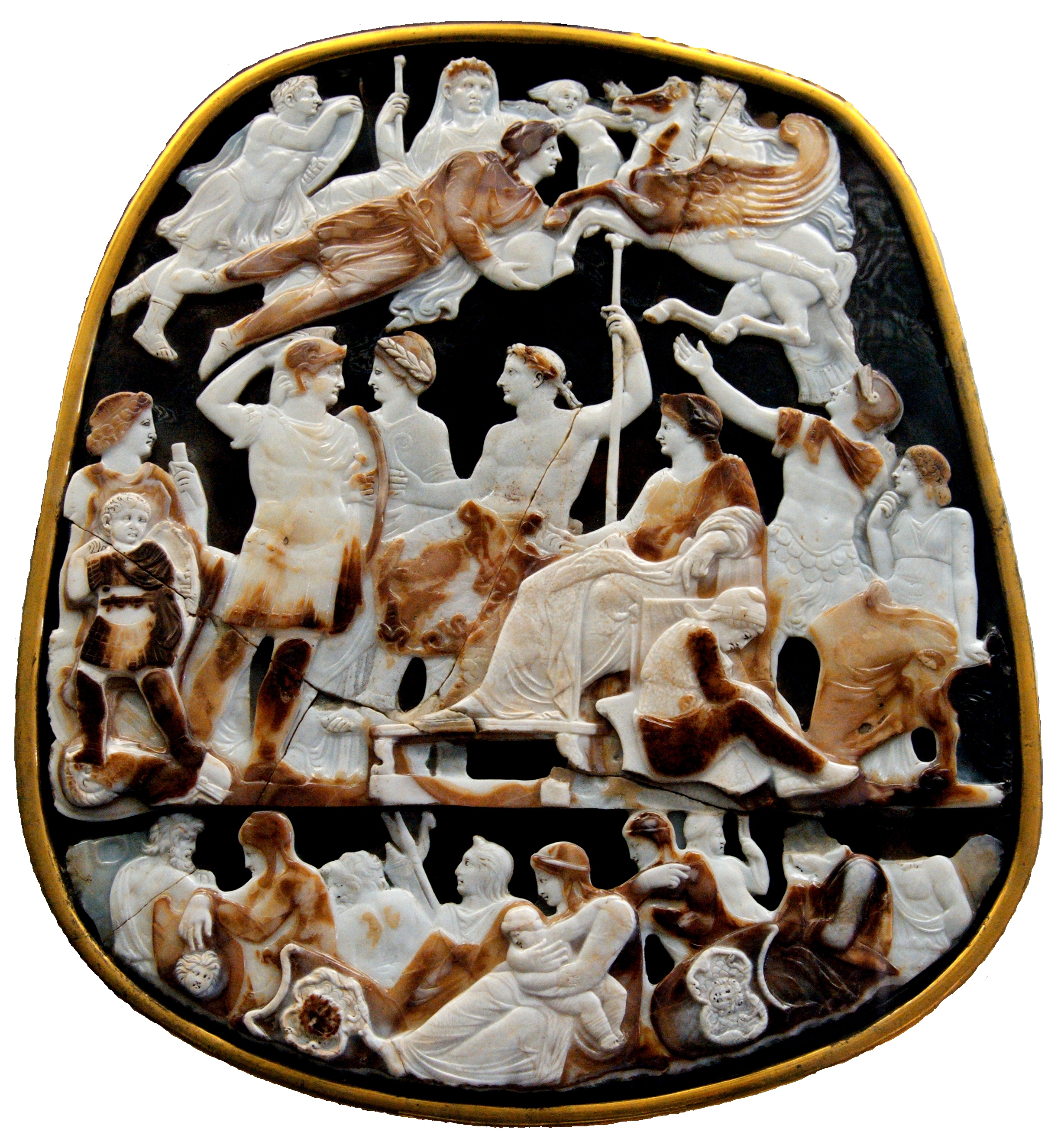
Circa, 41 CE, a member of the Julio-Claudian Dynasty commissioned a cameo that was given the title

Triumph of Joseph at the Court of the Pharaoh

The Cameo depicts the historical people involved in keeping the story of Rachel and Joseph the Nazar alive and celebrated. They wrote, directed, and starred in annual productions of “The Baker, Goddess the Mother” and her Son, “YaH-Zeus the Nazarene” who took her place on the cross. She possessed secret sacred knowledge of the healing properties of herbs and spices and saved the life of her beloved Son. (It was a myth performed for the people!)

“Mother Mary” and “Son of God” both lived on to inspire their subjects.

The moral of the myth is that YaH-Zeus believed women are as valuable as men. In fact, His actions seem to suggest that He believed His Mother’s life was more valuable than His own.

Paul and patriarchal priests and bishops rejected this original version of the Crucifixion and fabricated their own myth which they claimed was factual and historical. They preserved the Scapegoat superstition popular with imperfect men, and they gave YaH-Zeus the Nazarene a new hometown, “Nazareth.” They lied, and their reason was to keep women subservient to men!

Legacy of the First Christian Heretic

Thomas Paine and Thomas Jefferson can be aptly labeled “Christian Heretics.” They admired and praised “Jesus” but rejected Orthodox Christian doctrines. Paine wrote, “I do not believe in the creed professed by the Jewish church, by the Protestant church, nor by any church that I know of.” Regarding the bible, he mused, “…it would be more consistent that we call it the word of a demon than the word of God.”

Jefferson held special disdain for Paul, writing, “…Paul was the great Coryphaeus, and first corrupter of the doctrines of Jesus. These palpable interpolations and falsifications of his doctrines led me to try to sift them apart.”–Thomas Jefferson to William Short, Monticello, 13 April 1820.

Both, of course, rejected the nonsensical doctrine of vicarious atonement.

However, these Founding Fathers are just two in a long line that stretches back to the First Christian Heretic, Philo of Alexandria (circa 10 BCE to 74 CE). And it is Philo the Heretic who holds the key to solving the mystery of the historical Jesus: Was he Man, Myth, or like Christopher Reeve and Superman, both?

Philo, in “Every Good Man is Free,” alludes to a unique feature of the Biblical Hebrew used by the authors of the Tanakh: {Tanakh, also known as the Old Testament, is a collection of popular legends that were compiled, edited, and expanded during the Babylonian Captivity. At least two generations of Judean priests and scribes were confined and controlled by Cyrus the Great and his descendants. When Ezra returned to Jerusalem circa 458 BCE, he delivered the first known Tanakh. One shared text carried two very different messages, one for the uneducated, the other for the initiated. This was most likely King cyrus’ effort to peacefully unite two perpetually warring tribes.}

The Tanakh is written in consonants only, all caps. Vowels, spaces, and punctuation are determined by scribes, and they have more than one choice:

“Then one [Essene] takes up the holy volume [Tanakh] and reads it, and another of the men of the greatest experience comes forward and explains what is not very intelligible, for a great many precepts are delivered in enigmatical modes of expression, and allegorically, as the old fashion was.”

Here”s an example of what Philo’s words reveal: Gen 1:1 opens with this string of consonants: BRSTBRLHM. Judean scribes add vowels and spaces that result in BaReSiT BaRa Elohim, translated word-for-word, “In the Beginning created God…” Philo and the Essenes were aware, however, that this translation is incorrect. LHM, rendered Elohim, is the plural of Eloah, “God.” When translated correctly, Elohim is “Gods.”

What Philo and the Essenes knew that we haven’t known is that LHM can be correctly rendered, eLa Ha eM, Hebrew words translated “Goddess the Mother.” She is introduced in the opening words of Genesis where, using all the same consonants in the same order, BRSTBRLHM, Essenes “…of the greatest experience…” find other equally valid words:

BaR iS, eT aB oR, eLa Ha eM, “Son of Man, Father Light, Goddess the Mother.” She, as LHM, is found throughout the Tanakh. This was the Essene-Nazarene Holy Trinity, borrowed by the Church Fathers but corrupted to eliminate equal respect for feminine attributes. A Goddess might suggest that women are as valuable as men, God forbid!

Judean priests did not agree that the Tanakh could be translated in more than one way, and the Early Church Fathers agreed. Irenaeus of Smyrna (circa 130 to circa 200 CE) defined and codified Orthodox Christianity. And, he exposed what he considered to be heresies, especially the Nazarene Heresy.

His signature work, “On the Detection and Overthrow of the So-Called Gnosis,” is better known as “Adversus Haereses.” He attacks his opponents as blasphemers – not just people with different opinions, but Heretics. Irenaeus is critical and dismissive and describes a particular opponent’s teachings as “farce” and “falsehood,” as he denigrates it:

“…collecting a set of expressions and names scattered here and there, they twist them … from a natural sense [his version] to a non-natural sense [Essene version].”

Philo knew of this method, adopted it, and shared it; furthermore, Philo venerates it:

“I admire the Lover of Wisdom…collecting and thinking it fit to weave together many things, though different, and proceeding from different sources, into the same web…he has put together in one most admirably arranged work, combining great learning of one kind with great learning of another kind.”

Philo devised a method for identifying and solving enigmas in scripture, both Old and New Testaments; it consists of twenty-one “rules.” I am an avowed heretic who fell in love with Philo, so I decided to test Philo’s rules. What I found in the Old Testament destroys the foundation on which Orhtodox Christianity was built:

Yahweh (translated LORD, all caps) is the name that Judean Kings co-opted from their invented deity of the same name. These Kings, like their imagined deity, were authoritative and misogynistic and used threats and violence to control the members of their tribes, the Judeans. Instilling fear through violence was their method of controlling and exploiting people. Old Testament stories about YHWH are about the Kings, not the deity.

Eloah and eLa Ha eM are the names that Israelite Kings and Queens co-opted from their invented deities of the same names, aBa eL and eLa Ha eM, “Father God and Goddess the Mother.” The Essene-Nazarenes were a small remnant of the Israelite tribe after it split in two. A magic trick on Mt. Carmel, a chemical that ignited wood when water was poured on it, convinced most of the Israelites to abandon Father-Mother (Ba’al-Asherah) and follow YHWH (1 Kings 18:20-40).

Like their imagined deities, these Kings and Queens viewed members of their tribes as innocent children. Love and compassion were their methd of encouraging, educating, and persuading people to emulate these qualities. Jesus knew Father-Mother well; he called to them before and during the Crucfixion, “Abba, Abba” (Mk 14:36); “Ela, Ela” (Mk 15:34). 

The first-century Julio-Claudians ruled a vast, prosperous Roman Empire; however, one religious sect remained hostile and combative. The Judeans would never abandon YHWH in favor of any Roman God and Goddess. So, a wise Julio-Claudian devised a plan. YHWH and Zeus became “YH-Zeus the Nazarene,” which evolved into “Jesus.” His father was “Joseph,” a descendant of “Joseph the Nazar,” introduced at Gen 49:26 where he is “blessed” by a deity “with breasts and womb.”

Oh, but wait! “Jesus” wasn’t called “The Nazarene” because his ancestor was “Joseph the Nazar.” Jesus was called “The Nazarene” because he came from Nazareth (Mt 2:23). Or is this an interpolation devised to separate “Jesus the Nazarene” from “Joseph the Nazar”? Why would anyone want to do that?!

Let’s take a closer look. Joseph the Nazar’s mother was Rachel, derived from oRaK eLa, “Spirit of Goddess.” Rachel “died” in the place named BTLHM, (Gen 35:19). The Judean translation of BTLHM is BeT LeHeM (“house of bread”); the Essene translation is BeTuLaH eM, “Virgin Mother” and BaT eLa Ha eM, “Daughter, Goddess the Mother.” The enigma in BTLHM reveals that Rachel “died” in order to become “Daughter, Goddess the Mother,” aka, “Virgin Mother.”

As LHM, She is later found with Joseph the Nazar, born a Prince but held in slavery at Pharaoh’s court in Egypt. Pharaoh has worrisome dreams that no one can interpret. He turns to Joseph and Joseph turns to LHM. She helps him interpret Pharaoh’s dreams as a warning of a coming drought. Her wigHer wisdom, transmitted to Pharaoh by her son, leads Pharaoh to store some of the grain produced in years of rain to feed people during years of drought. Grateful, Pharaoh sets them free and makes Joseph the Vizier over Egypt. The freeing of Joseph and LHM was Joseph’s Triumph at the Court of the Pharaoh (Gen 41:1-45).

The first crucifixion in the Bible (Gen 40:19-22) was carried out right here in Pharaoh’s court two years before Joseph’s Triumph. The “Chief Baker” had done something to anger Pharaoh (we aren’t told what). The climax of the Judean version of the first crucifixion is,

We eT SaR Ha oPiM TaLaH KaSaR PaTaR LHM YSP.

“…but the chief baker he impaled, just as Joseph had interpreted to them.”

The Essene-Nazarene version using the same consonants but with different vowels and spaces reveals something else:

We eT iSha oRaH oPiM eT eLaH, KiSaR PeTer eLa Ha eM, YoSeP.

“But the Woman of Light, ‘Baker,’ is Elah, Kisar’s firstling, Ela the Mother of Joseph.”

{“Kisar” is the Sumerian-Babylonian “First Mother.” Ki means “Earth, ” Sar means “princess.” Kisar is a candidate for the etymology of Rome’s “Caesar” and Germany’s “Kaisar.”}

Some time around 41 CE, concurrent with Claudius becoming Rome’s Emperor, a Julio-Claudian commissioned two cameos. The first can be dated by the child in the middle row, left side, identified as future Emperor Nero, born in 37 CE. He appears to be about four or five years old.

This cameo was among three dozen or so artifacts purchased by Louis IX from Baldwin II, Latin emperor at Constantinople. They are listed in documents as “Relics of Christ.” In fact, the Sainte-Chappel (“Holy Chapel”) was built to house Louis IX’s collection of Relics of Christ. These Relics of Christ arrived in Paris in August 1239. When no one could figure out why the cameo was called “Triumph of Joseph at the Court of the Pharaoh,” the name was changed to “Great Cameo of France.” Apparently, “Relics of Christ” didn’t ring any bells. Or maybe it did.

The Cameo depicts four generations of Julio-Claudians. In the heavens (left to right): Mark Antony holding the Shield of Mars; Emperor Augustus holding the Spear of Mars; Cleopatra holding the Orb of Ra; Julius Caesar riding Pegasus.

Middle row, left to right: Julia Minor (holding Nero); Germanicus and wife Agrippina Major; Emperor Tiberius and Empress Livia; Claudius and wife Agrippina Minor. Sitting with head bowed in shame is the “assassinated” Emperor, “Caligula.”

The cameo supports what Philo reveals elsewhere: stories of assassinations and early deaths among this Royal Dynasty, posing as Gods and Goddesses, may not be literally true. Like Rachel, Caligula “died,” but he emergd as another personality who became quite prominent in his own right. Here’s a clue: Caligula was raised by his aunt Agrippina and uncle Germanicus (also “deceased” before the cameo was created). In his new role, Caligula assumed the name of his biological father, “Lucius Aemilius Paullus.”

The bottom row is most intriguing. Here we find the secret identities of the Julio-Claudians, the mythological characters they portrayed in annual festivals that celebrated “Gods and Goddesses.” Depicted underground are Jesus the Nazarene, Mary the Magdalene, Joseph the Nazar, Mother Mary and Baby Jesus.

Evidence hidden in the Essene-Nazarene rendering of Old Testament legends reveals that the original first-century Crucifixion was a dramatization of Joseph’s Triumph at the Court of the Pharaoh, the freeing of Goddess Mother and her Son. The moral message in these stories of a freedman and a freedwoman is that no one should ever be enslaved because everyone has unknown royal ancestors. All are created equal in spite of outward appearances or circumstances. Didn’t “Jesus” suggest the same?

The Julio-Claudian Crucifixion Myth must have gone something like this:

Judean Kings believed a woman who claimed to be a Goddess was a heretic; therefore, Goddess the Mother is sentenced to be crucified. YH-Zeus loves his Mother and values her so much that he offers his life in place of hers; YH-Zeus is strapped to the cross while eLa Ha eM and BaT eLa Ha eM mourn and pray at his feet. Fortunately, Mother knows the healing properties of herbs and spices; she concocts an elixir which she and Mary Magdalene take to the tomb. The three emerge victorious over death. Goddess the Mother and her Son YH-Zeus are more powerful than YHWH alone. Praise Goddess!

Oh, but not so fast! The patriarchal Judean priests refused to accept the Goddess, and some Judeans were too fearful of YHWH to accept Mother and Son. So for them, YH-Zeus was turned into the popular Scapegoat, and the Judean Crucifixion Myth became a vicarious atonement. Tolerance was the key to success as the newly fabricated deities offered something for everyone. The golden Age of Rome and the New Jerusalem were ushered in side-by-side.

Unfortunately, this relative peace lasted less than three hundred years – until the conversion of Emperor Constantine and the convening of the Council of Nicea in 325. Prior to this time, Roman Emperors allowed both versions of YH-Zeus to coexist. However, a few decades after that contentious and fateful Council, Emperors, Popes and Bishops resolved to prohibit all religions except their Nicene approved version of Christianity. Tolerance of other religions ceased to exist, leading to the unspeakable slaughter in the name of competing concepts of God and Gods, all imagined into existence by mortal men.

Bishop Epiphanius of Salamis (circa 315 to circa 403) composed the Panarion, a compilation of all the heresies known to him. His quotations are the only surviving fragments of many suppressed and destroyed texts; for this we owe him a debt of gratitude. Perhaps this offsets some of the damage he caused by adding support ot Irenaeus’ lies about why Jesus is called “The Nazarene.”

Epiphanius’ contemporaries, the equally intolerant Emperors Theodosius and his son Honorius, set about to destroy all evidence of all religions except their Nicene-Christianity. Temples to Gods and Goddesses throughout the Roman Empire were destroyed; heretics who refused to convert were tried, convicted, tortured, and executed.

One of the most notable destructions was the Baker’s Tomb on the east side of Rome. For some reason, perhaps superstition, rather than tearing it down, as they did other temples and monuments, Honorius buried the Tomb and Claudius’ Porta Maggiore under a massive structure which he also named Porta Maggiore. No one would ever have a reason to question the fate of Claudius’ Porta Maggiore. The Porta Maggiore remained, but in name only.

Honorius’ Porta Maggiore
Vasi Plate No. 7 [2]

Giuseppe Vasi preserved an image of Honorius’ Porta Maggiore as it appeared circa 1748. Plate No. 7 is one of several plates described as “Vasi’s Roman views.” These plates were the photographs of that era.

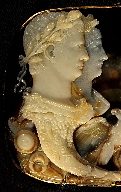
The second cameo commissioned circa 41 CE depicts the man and woman (left) who played the roles of “Jesus and Mary Magdalene.” Yes! We have images! and busts!

The couple on the right is their daughter and their son-in-law, Emperor Claudius (the men were also half brothers.).

Gemma Claudio Cameo [3]
Commissioned circa 41 CE

The historical couple called “YH-Zeus and Mary Magdalene” died in 74 CE. At the time of their deaths, he was known as Polemon and she was Atonia Caenis, Emperor Vespasian’s powerful freedwoman and co-ruler. Caenis is the name of a Greek Goddess whom the God Poseidon transformed into a man. Their remains were placed in the Baker’s Tomb, correctly identified as a monument to honor The Baker. However, rather than a freed-man and his wife, they are a freed-woman and her husband. And in spite of evidence that contradicts the claim, the Baker’s Tomb is often dated to the first century BCE. {Two sources challenge the first century BCE dating preferred by the Church: (1) John Henry Parker, The Archaeology of Rome, Part IX, “Tombs in and Near Rome” (Oxford: James Parker and Co; London: John Murray, Albemarle Street, 1877), 34-5. (2) Second century historian Pliny the Younger wrote letters that describe a monument to claudius’ freedman Pallas that was constructed on the east side of Rome, the exact location of the Baker’s Tomb (Loeb, VII. 29 and VI to Montanus, n.d. LCL 59:12-13).}

In 1838, twenty-two years before the American Civil War, Pope Gregory XVI, the anti-slavery Pope, ordered that Honorius’ massive structure be dismantled. After nearly fourteen hundred years, the heavily-damaged Baker’s Tomb and Claudius’ Porta Maggiore were exposed to the light once again.

In 1839, the year after uncovering the long-buried tomb of former slaves, Pope Gregory XVI gave pro-slavery churches an unsolicited gift: tens of thousands of new members. He wrote an apostolic letter forbidding Catholics to participate in the Atlantic Slave Trade: “We warn and adjure earnestly in the Lord faithful Christians of every condition that no one in the future dare to … reduce to servitude, or lend aid and favor to those who give themselves up to these practices, or exercise that inhuman traffic by which the Blacks, as if they were not men but rather animals, having been brought into servitude, in no matter what way, are, without any distinction, in contempt of the rights of justice and humanity…”

Claudius’ powerful freedman Antonius Pallas and Vespasian’s powerful freedwoman Antonia Caenis were/was one and the same person. She is better known as Philo of Alexandria, the “First Christian Heretic” and the creator of the keys to finding Her Story.

Claudius’ Porta Maggiore

Pope Gregory knew, as all Popes have known, that the remains placed in the Baker’s Tomb were the historical couple called “Jesus and Mary Magdalene.” And they also know that the Julio-Claudian Crucifixion Myth predates their own. Now who are the true heretics?

PAXAMOLUX!

COPYRIGHT 2019, P.J. GOTT, SPRINGFIELD, MO

[1] Image from Wikimedia: Copyright, http://upload.wikimedia.org/wikipedia/commons/f/f8/Great_Cameo_of_France_CdM_Paris_Bab264_white_background.jpg

[2] Image from “Rome Art Lover”: copyright: https://www.romeartlover.it/Vasi07.jpg

[3] Image from Ancient Rome Website: http://ancientrome.ru/art/artwork/glyptics/cameos/c0253.jpg

This article is a brief synopsis of information reported in three books by P.J. Gott and Logan Licht:

Following Philo to the Early /Church Fathers, The Cox Ukkers Who Rejected Jesus’ Feminism, Embraced Paul’s Misogyny, and Fabricated Christianity on a Foundation of Lies (Published March 2019).

Following Philo from Ba’al and Asherah to Jesus and Mary Magdalene (Published 2017).

Following Philo in Search of The Magdalene, The Virgin, The Men Called Jesus (Published 2015).

Pythagoras of Samos

Pythagoras: Architect of the Old Testament

(circa 575 to circa 495 BCE)

Nothing has caused more wars, torture, and violent deaths than disagreements over religion. Today’s major conflicts are, at their core, caused and perpetuated by intolerance of religious differences. Human rights violations are the result of differing opinions over who is more valuable, who should be served, and who should do the serving. Many argue that the answers to these disputes can be found in a sacred text – their sacred text, of course.

Throughout history, some of the more benevolent rulers attempted to put an end to this deity-based hatred and violence. Obviously, all attempts have failed.

The most notable attempt was initiated by the Babylonian King who ruled from c. 605 to c. 562 BCE, Nabuchadnezzar, which literally means, “O god Nabu, preserve/defend my firstborn son.” The Book of Daniel describes Nabuchadnezzar as the King who took Daniel to Babylon to be trained in “the learning and the tongue of the Chaldeans,” i.e., Biblical Aramaic.[1][2]

Archaeological evidence suggests that not all Judeans were relocated to Babylonia. Some escaped and fled to Egypt. It can be surmised, however, that rigid, belligerent Judean priests and scribes were among those escorted to Babylonia for rehabilitation, reeducation, and reprogramming.[3]

The Captivity ended officially under Cyrus the Great c. 539 BCE.[4]  By this time, more than two generations of priests and scribes had been subjected to Babylonian philosophy and religion. Their return to Jerusalem was gradual, and many chose to remain with their captors.[5] Those who stayed would have been encouraged to embrace Nabu and Inanna/Ishtar, the Goddess associated with the planet Venus whose symbols are the lion and the eight-pointed star. Julius Caesar claimed descent from Venus; Emperor Octavian’s name is a salute to Venus; octo is Latin for “eight”; his sister was Octavia.

How likely is it that no effort would have been made to bring the Judean concept of their deity closer to the Babylonian concept of their deities? Why hold them for forty-plus years only to release them with their preexisting opinions that led to their confinement in the first place? This is a question that has been largely ignored, but one that needs to be answered.

Biblical texts produced during the Babylonian Captivity include: Book of Jeremiah; 2 Kings; 2 Chronicles; Ezra; Daniel; Susanna, Bel and the Dragon; Story of Three Youths; 1 Esdras; Tobit; Book of Judith; Book of Lamentations.[6] Not all of these made the final cut and into today’s Old Testament.

It’s important to know that the Hebrew script utilized in the Babylonian and post-exilic period differs from the script found in earlier Biblical texts.
This is also known as the Persian Period, when the final redaction of the Five Books of Moses is generally dated.[11] Jan Joosten notes, “In the late books of the Bible – Chronicles, Ezra-Nehemiah, Ester – an archaic form of Hebrew is reused in a way that indicates it was ‘lifted’ from the earlier text and revivified on the basis of exegesis.”[7] “Some words took on different meanings. The authors’ conscientious choice to continue writing in Hebrew set it apart almost as a sacred language.”[8]

Dated by his own writings and snippets of information from historians’ accounts, Pythagoras lived from c. 575 to c. 495 BCE.[9] His biographer, Iamblichus, writes,

“In Egypt he frequented all the temples with the greatest diligence, and most studious research, during which time he won the esteem and admiration of all the priests and prophets with whom he associated. Having most solicitously familiarized himself with every detail, he did not, nevertheless, neglect any contemporary celebrity, whether sage renowned for wisdom, or peculiarly performed mystery; he did not fail to visit any place where he thought he might discover something worthwhile. That is how he visited all of the Egyptian priests, acquiring all the wisdom each possessed. He thus passed twenty-two years in the sanctuaries of temples, studying astronomy and geometry, and being initiated in no casual or superficial manner in all the mysteries of the Gods. At length, however, he was taken captive by the soldiers of Cambyses, and carried off to Babylon. Here he was overjoyed to associate with the Magi, who instructed him in their venerable knowledge, and in the most perfect worship of the Gods. Through their assistance, likewise, he studied and completed arithmetic, music, and all the other sciences. After twelve years, about the fifty-sixth year of his age, he returned to Samos.[10] (Emphasis added.)

Pythagoras was taken to Babylon c. 525 BCE, which falls within the post-exilic period (c. 537 to c. 430 BCE). He would have encountered Jewish priests, scribes, and sages who lingered there. Ezra did not return to Jerusalem from the Babylonian Exile with the Tanakh until “…the seventh year of King Artaxerxes” (Ezra 7:7). Artaxerxes I was King from c. 465 to c. 424 BCE, dating the return of the Tanakh to Jerusalem c. 458 BCE.

Therefore, the first Tanakh was conceived, and produced, during the reigns and under the influence of Cyrus the Great (c. 560 to c. 530 BCE);[12] his elder son Cambyses II (c. 525 to c. 522 BCE); Cyrus’ younger son Bardiya (c. 522 BCE); Cyrus’ son-in-law, Darius (married Cyrus’ daughter Atossa; ruled c. 522 to c. 486 BCE); Darius and Atossa’s on Xerxes I (c. 519 to c. 465 BCE); Xerxes’ third son Artaxerxe I (c. 465 to c. 424 BCE).[13]

Examined carefully and without preconceived notions, it can be seen that the Tanakh was compiled, edited, and written by an unidentified word-genius in Babylon who created a new unique version of Hebrew that few scholars have been willing to acknowledge: One text carries two different messages.

The version people revere, the one used to translate modern Christian versions of the Tanakh, was composed for citizens who were more likely to respond to fear and superstition; YHWH served this purpose quite well and was adopted by the YH-udean Kings for their tribe, the Judeans.

The other version was for subjects more likely to respond to reason and logic; BL and LHM, “Father El and Goddess the Mother,” also known as Isha Ora (“Woman Light”), served this purpose and were adopted by the Israelite Kings and Queens for their tribe, the Isha Ora lites . The dual-purpose language of the Tanakh was designed to peacefully unite perpetually warring tribes by placing two “Sacred Texts” into one “Sacred Gook” for all to share under one roof in one Temple. 

The stories of the interactions that pit Ba’al and Asherah (“Father God” and “Woman Light”) against their arch-enemy, King YHWH, can be found in both versions but with different outcomes, all produced during and after the time Pythagoras was in Babylon.

The genius of the Tanakh comes from the fact that it is written in consonants only. Vowels, spaces, and punctuation were determined by scribes, and they were given more than one choice. Philo of Alexandria refers to this unique characteristic when writing of the Essenes:

“Then one [Essene] takes up the holy volume [Tanakh] and reads it, and another of the men of the greatest experience comes forward and explains what is not very intelligible, for a great many precepts are delivered in enigmatical modes of expression, and allegorically, as the old fashion was.”[14] (Emphasis added.)

Josephus, an important first century Jewish historian, ties Essenes to Pythagoreans: “The Essenes also, as we call a sect of ours … live the same kind of life as do those whom the Greeks call Pythagoreans.” (Josephus, Antiquities of the Jews, 1999 (15.10.4 (371), 521. Emphasis added.)

The first century Greek historian Plutarch writes of Pythagoras and uses some of Philo’s key terminology :

“Pythagoras greatly admired the Egyptian priests and copying their symbolism and secret teachings incorporated his doctrines in enigmas.” And, “If you listen to the stories about the gods in this way…you may avoid superstition which is no less an evil than atheism.” [15]

Here’s an example in the Old Testament of “precepts…delivered in enigmatical modes of expression” and “secret teachings incorporated” in a “doctrine” written in “enigmas“:

Gen 1:1 opens with the Hebrew letters BRSTBRLHM, traditionally rendered BaReSiT BaRa eLoHiM and translated word-for-word, “In the beginning…created…Gods…” This is always translated incorrectly as “In the beginning God created…” This is incorrect because the im suffix creates the plural of Eloah, the Hebrew word for the singular “God.” Elohim is plural: “Gods.”

Christian apologists argue that “Gods” refer to the Christian Holy Trinity, “Father, Son, Holy Spirit,” the three-in-one deity. And to a certain extent, they are right – almost; they just don’t know it. And, here’s where the genius of the Babylonian influence can be seen:

The same consonants in the same order, BRSTBRLHM, can be correctly rendered BaR iS, eT aB oR, eLa Ha eM, “Son of Man, Father Light, Goddess the Mother,” the Essene’s Holy Trinity. This rendition solves the problem of the mysterious “Son of Man” sayings in the New Testament; furthermore, it identifies the Holy Trinity that includes “Goddess the Mother,” suggesting that women are as valuable as men, God forbid!

Pythagoras’ wife Theano[16] was also a philosopher as were their daughters, Damo,[17] Agrinote,[18] and Myia.[19]

The name “Theano” can be translated “Divine” and/or “Goddess.” The famous Cleopatra of Egypt’s full name was Cleopatra Thea-Philo Pater, translated, “Father-loving Goddess.” It is likely that “Thea ano” was derived from “Thea Anna,” which identifies a specific Persian Goddess, Anahita. She was one of the earliest “Great Mother Goddesses,” and she has been associated with Egypt’s Anat and Rome’s Athena.[20] Theano’s Goddess-name suggests she was married to the God-King, not a mere philosopher, circumstantial evidence that her husband was Cyrus the Great and that he was also known as Pythagoras. Like Ishtar, Anahita was associated with the planet Venus.

Throughout the years the Tanakh was being compiled and edited, the rulers were descendants of Cyrus the Great who were blood-and-duty-bound to carry on his legacy. So, what was Cyrus the Great’s legacy?

According to Xenophon in Cyropedia, c. 370 BCE, Cyrus was a unique King who was beloved by his subjects.

“And those who were subject to him, he treated with esteem and regard, as if they were his own children, while his subjects themselves respected Cyrus as their ‘Father’ … What other man but ‘Cyrus,’ after having overturned an empire, ever died with the title of ‘The Father’ from the people whom he had brought under his power? For it is plain fact that this is a name for one that bestows, rather than for one that takes away!”

So, “Father Cyrus,” like aB eL and eLa Ha eM, “Father God and Goddess the Mother,” treated his subjects as if they were his children, and they responded to him with reverence and respect.

King Nabuchadnezzer adopted the name of his deity, Nabu, a common practice in antiquity. Xenophon suggests that King Cyrus may have done the same. The etymology of the name Cyrus is the Greek word Kurios, which is translated “lord.” Plutarch notes, “…the sun … in the Persian language, is called Cyrus.”[21] This is another clue that ties “Pythagoras” to “Cyrus.”:

Queen Cleopatra named her son Helios and her daughter Selene, Greek for “Sun and Moon.” Furthermore, Luke 1:28 introduces the “Virgin Mary” to “Kurios,” just before she conceives “Jesus the Nazarene.” The significance of this introduction, which associates Jesus with King Cyrus, also known as, “Father,” has been overlooked and uninvestigated.

The name Pythagoras, like the name Cyrus, can also be associated with “Light” through Gematria, the ancient method of assigning a numerical value to a Hebrew name, word, or phrase based on its letters. It originated as an Assyro-Babylonian Greek system of alphanumeric code adopted into Jewish culture.[22]

The name Pythagoras has a numerical value of 864; the diameter of the sun is 864,000 miles. John Michell, in The Dimensions of Paradise, writes, “In the language of symbolic number 864 clearly pertains to a centre of radiant energy, the sun in the solar system.” [23]

The Tanakh is filled with numbers that can be associated with Pythagorean Sacred Numbers that demonstrate knowledge of Babylonian astronomy.[24] The key to finding them is recognizing that the Egyptian Royal Cubit is 1.728 feet, the result of converting a 12-in-per-foot measurement to a 10–inch-per-foot measurement: 12 divided by 10 = 1.2. Now, Cube it:

1.2 x 1.2 x 1.2 = 1.728, “Egyptian Royal Cubit (ERC).”

Genesis 6:15: Noah’s Ark measures 300 cubits x 50 cubits x 30 cubits:

1.728 x 300 = 5184 ERC

1.728 x 50 = 864 ERC and “Pythagoras”

1.728 x 30 = 518.4 ERC

Precession of the equinox is 25,920 years x 2 = 51,840 years.

Exodus 25:10: The Ark of the Covenant measures 2.5 cubits x 1.5 cubits x 1.5 cubits:

1.728 x 2.5 = 4.32 x 2 = 8.64 ERC (diameter of sun; “Pythagoras”)

1.728 x 1.5 = 2.592 ERC (precession is 25,920 years)

Most of the measurements in the Tanakh can be found in Babylonian astronomy measurements when the Egyptian Royal Cubit is applied. It was the authors’ way of identifying themselves as Pythagoreans. Furthermore, a 25-hour day consists of 86,400 seconds, and a normal rate of 60 beats per minute is the daily total for the human heart. And, just to self-identify as a Pythagorean, “Luke” inserted six numbers in Chapter 1:

5 x 6 x 6 x 3 x 8 = 4320 x 200 = 864,000, the diameter of the sun.

4320 divided by 2 = 2160, the diameter of the moon.

432 x 432 = 186,624, the speed of light within .0012 miles per second.

Iamblichus notes that Pythagoras spent twenty-two years in Egypt, “…studying astronomy and geometry…” before being taken to Babylon where he associated with the Magi, who, “…instructed him in their venerable knowledge, and …studied and completed arithmetic, music, and all the other sciences” for twelve years. [25] Who can forget the visit from the Magi after the birth of Jesus? (Mt 2:1-2).

In Egypt Pythagoras would have encountered Judeans who took refuge there after the destruction of the Kingdom of Judah in 597 BCE. Iamblichus stresses “…he won the esteem and admiration of all the priests and prophets with whom he associated.” This would include Judean priests and prophets. After twenty-two years, he would have been quite familiar with their legends and texts, as well as legends and texts from other traditions, including Sumerian-Babylonian.

This aptly describes the Tanakh. It’s clear that the two creation stories that open Genesis are derived from two different traditions. The first version never mentions YHWH; the second version begins at Gen 2:4 and is all about YHWH and LHM, who was introduced in the opening words of Gen 1:1 as “Goddess the Mother” or “Gods,” which would refer to Eloah and Ela Ha Em. It’s here that the competing deities become One, assumed by Judeans to be male, but known to the Essenes as God and Goddess. This Jewish sect was egalitarian; men and women were equal in value!

The Serpent in the Garden of Eden first appears at Gen 3:1. The Hebrew word translated “serpent” is nachash; the same word is translated elsewhere in the Tanakh as: divination, divined, enchantments, indeed practice divination, indeed uses, interprets omens, practice divination, took as an omen, used divination. [26]

A Hebrew nachash haggan,[27] “Serpent in enclosure,” is a Greek Python in agora. Python+agora becomes Pyth agora, the purveyor of “Knowledge of Good and Evil.” Whomever eats of the fruit of that tree will know right from wrong and respond to deities who are parent-teachers, rather than tyrants. Those who do not eat of that tree require explicit instructions, something like the Ten Commandments accompanied by threats of eternal suffering if the rules are not obeyed. Fear was their driving force.

Pythagoras’ mother’s name was Pythia; according to Iamblichus, the Pythia at the Oracle of Delphi prophesied to her that she would “…give birth to a man supremely beautiful, wise, and beneficial to humankind.” [28]

The Oracle of Delphi was located on Mount Parnassus in the valley of Phocis. According to legend, the hill was guarded by a giant serpent called Python, who was a follower of the cult of Gaia for hundreds of years. After killing Python, Apollo claimed Delphi as his own sanctuary.[29] The name Pythia is derived from Pytho, the original name of Delphi, the location of the famous Oracle:

“The Pythia was established at the latest in the 8th century BC, and was widely credited for her prophecies inspired by being filled by the spirit of the god (or enthusiasmos), in this case Apollo. The Pythian priestess emerged pre-eminent by the end of 7th century BC and would continue to be consulted until the 4th century AD. During this period the Delphic Oracle was the most prestigious and authoritative oracle among the Greeks, and she was without doubt the most powerful woman of the classical world. The oracle is one of the best-documented religious institutions of the classical Greeks. Authors who mention the oracle include Aeschylus, Aristotle, Clement of Alexandria, Diodorus, Diogenes, Eruripides, Herodotus, Julian, Justin, Livy, Lucan, Nepos, Ovid, Pausanias, Pindar, Plato, Plutarch, Sophocles, Strabo, Thucydides and Xenophon.” [30] (Emphasis added.)

Pythagoras has never been considered as a possible contributor to the Tanakh. After all, he was a Greek philosopher, not a Judean priest or scribe. This preconceived notion might be worthy of scholarly reconsideration. His twenty-two years of study in Egypt, documented by his biographer Iamblichus and repeated by Plutarch, gave him the time needed to perfect the new Hebrew script that he took back to Babylon. It was all he needed to create the dual-text Tanakh to carry a multitude of traditions popular around the known world. Genius, indeed!

COPYRIGHT 2019, P.J. GOTT, SPRINGFIELD, MO

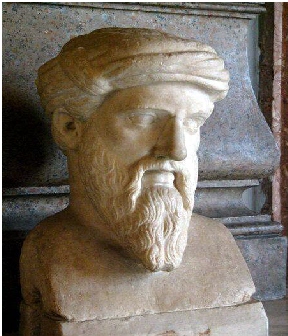
Image of Bust of Pythagoras of Samos currently on display at the Capitoline Museums, Rome, Italy. Image downloaded from: Pythagoras – Wikipedia Joost-Gaugier, Christiane L. (2006), Measuring Heaven: Pythagoras and his Influence on Thought and Art in Antiquity and the Middle Ages, Ithaca, New York: Cornell University Press, ISBN978-0-8014-7409-5

Footnotes:

[1] Collins, John J. (1999). “Daniel.” In Van Der Toorn, Karel; Becking, Bob, van der Horst, Pieter Willem. Dictionary of Deities and Demons in the bible. Erdmans, p. 219; Wikipedia, “Nebuchadnezzar II”: https://en.wikipedia.org/wiki/Nebuchadnezzar II.

[2] “Aramaic Language.” “Chaldee” or “Chaldean Aramaic” used to be common terms for the Aramaic of the Chaldean dynasty of Babylonia. It was used to describe Biblical Aramaic, which was, however, written in a later style.” Wikipedia: https://en.wikipedia.org/wiki/Aramaic_language#Middle_Aramaic. 

[3] Coogan, Michael (2009). A Brief Introduction to the Old Testament. Oxford: Oxford University Press.

[4] Encyclopaesia Judaica. 3 (2nd ed.), p. 27.

[5] Stern, Ephraim (November-December 2000). “The Babylonian Gap.” Biblical Archaeology Review.

[6] “Babylonian Captivity,” Wikipedia: https://en.wikipedia.org/wiki/Babylonian_captivity#cite_note-Finkelstein-16.

[7] Joosten, Jan (2017). “How Hebrew Became a Holy Language,” Biblical Archaeology Review, January/February 2017 (emphasis added).

[8] “How was the bible Written During and After the Exile?” https://www.biblicalarchaeology.org/daily/biblical-topics/hebrew-bible/how-was-the-bible-written-during-and-after-the-exile/. Emphasis added.

[9] William Keith Chambers Guthrie, (1978), A History of Greek Philosophy, Volume 1: The Earlier Pre-Socratics and the Pythagoreans Cambridge University Press, p. 173.

[10] Iamblichus, Life of Pythagoras, Kenneth Sylvan Guthrie, trans. (Chapter IV: “Studies in Egypt and Babylonia”), 9. Emphasis added.

[11] Finkelstein, Israel; Silberman, Neil Asher (2001). The Bible Unearthed: Archaeology’s New Vision of Ancient Israel and the origin of Its Sacred Texts. Simon and Schuster. ISBN 978-0-684-86912-4

[12] Dandamayev, Muhammad A. “Cyrus III. Cyrus II the Great.” iranicaonline.org. (Encyclopaedia Iranica 1989), p. 71).

[13] Collins, John J.’ Manning, J.G. (2016). Revolt and Resistance in the Ancient Classical World and the Near East: In the Crucible of Empire. BRILL. p. 99.

[14] Yonge (2013): Philo, “Every Good Man is Free” (12.82), 690. Emphasis added.

[15] Plutarch. Isis and Osiris, “introduction,” (Loeb Classical Library, 1914, Babbit trans.), Bill Thayer’s website. Emphasis added.

[16] “Theano (philosopher), ” Wikipedia: https://en.wikipedia.org/wiki/Theano)_(philosopher).

[17] “Damo (philosopher),” Wikipedia: https://en.wikipedia.org/wiki/Damo_(philosopher).

[18] “Arignote,” Wikipedia: https://en.wikipedia.org/wiki/Arignote.

[19] “Myia,” Wikipedia: https://en.wikipedia.org/wiki/Myia.

[20] “Journeying to the Goddess,” https://journeyingtothegoddess.wordpress.com/2012/03/19/goddess-anahita/

[21] Plutarch, Artoxerxes in “Parallel Lives.” https://en.wikipedia.org/wiki/Cyrus#cite_note-8

[22] “Gematria,” Wikipedia: https://en.wikipedia.org/wiki/Gematria.

[23] Michell, John; The Dimensions of Paradise (Kempton, Adventures Unlimited Press, 2001), 170-1.

[24] Wikipedia, “Babylonian Astronomy”: https://en.wikipedia.org/wiki/Babylonian_astronomy.

[25] Iamblichus, Life of Pythagoras, Kenneth Sylvan Guthrie, trans. (Chapter IV: “Studies in Egypt and Babylonia”), 9 (emphasis added).

[26] Biblehub: “nachash”: https://biblehub.com/hebrew/5172.htm

[27] Biblehub: “haggan”: https://biblehub.com/hebrew/1588.h5m

[28] Riedweg, Christoph (2005) [2002], Pythagoras: His Life, Teachings, and Influence (Ithaca, New York: Cornell University Press), 62.

[29] “Pythia, the Oracle of Delphi,” Ancient Origins: https://www.ancient-origins.net/myths-legends/pythia-oracle-delphi-001641 (emphasis added.)

[30] “Pythia,” Wikipedia: https://en.wikipedia.org/wiki/Pythia (emphasis added).

Kings and Queens

Yahweh, Abba El; Ela Ha Em, Isha Orah

Philo Judeaus, a first-century Jewish theologian, codified an ancient secret method for identifying and interpreting enigmas and parables written into Scripture. Plutarch alluded to it and identified Pythagoras as one who learned it and took it to Babylon c. 525 BCE.

In 2002, Gott and Licht recognized Philo’s clues to enigmas embedded in Luke’s Gospel and began testing the method on unresolved biblical questions. Philo’s Rules can be used to interpret both the Old and New Testaments.

Philo’s most important revelations turn Old Testament fantastic tales of a rib turned into a woman and a talking serpent into ancient traditions that rational minds, unencumbered by preconceived notions and religious dogma, can interpret and explain.

Philo reveals, for example, that YHWH (translated in the Bible as LORD, all caps) was the name assumed by ancient Judean Kings who represented an imagined deity that was given the same name. The Kings, like their deity, were narcissistic and authoritarian. They used threats and violence to control the members of their tribes, the Judeans. Instilling fear through violence was their philosophy and their method. Notably, early versions of YHWH included a wife; however, she was eliminated when physical strength became valued more than nurturing, wisdom, and compassion. Most experts identify the figurines in the image below as “Great Mother Goddessses.”

Judaean female clay “pillar figurines”. Jerusalem, Beer-Sheva, Tel Erani (8th-6th BCE). Wikimedia / Israel Museum

Additionally, Eloah (translated in the Bible as “God”) and LHM (translated incorrectly as “God” but translated correctly, “Goddess the Mother”) were names assumed by ancient Israelite Kings and Queens. They also represented imagined deities that were given the same names, aB-eL (Ba’al) and eLa Ha eM, “Father God and Goddess the Mother.” Eloah was also known as “Father Light,” Hebrew Ab Or; LHM was also known as “Woman Light,” Hebrew Isha Ora, which evolved into Asherah.; Isha ora Ela became Israel, the name of their tribe. Like their imagined deities, these Kings and Queens treated the members of their tribes as beloved children. Love and compassion were their philosophy and their method.

Claims of Venusian origins permeate the Hebrew Bible and other ancient texts, and archaeology lends circumstantial support. In the Sumerian creation story, the Enuma Elish, the Venusian “Beings” are called Sar and Sara, translated “Lord” and “Lady” and/or “Prince” and “Princess.” Stories in the Hebrew Bible and the Enuma Elish seem to describe these “Beings” manipulating the DNA in Earthlings (Adamah), the humanoid life-form which they found on Earth. They introduced Venusian DNA to produce hybrid humanoid-Venusians that would be supported by Earth’s atmosphere. Those with predominantly Venusian DNA became the Tribe of Isha Orah; they were designed to be “Rulers.” Those with predominantly Earthling DNA became the Tribe of Judah; they were destined to be “Workers.”

These stories may seem far-fetched but for these recent articles: “NASA Looking Toward Manned Mission To Mars ‘Sometime In The 2030s” (https://www.huffingtonpost.com/entry/nasa-looking-toward-manned-mission-to-mars-sometime-in-the-2030s_us_5bfaf0e9e4b0eb6d930fac96

And, “China is at the forefront of manipulating DNA to create a new class of superhumans” https://qz.com/750908/the-future-of-genetic-enhancement-is-in-china-and-india/

Finally, give some thought to these observations about Venus: “Through studies of the present cloud structure and geology of the surface, combined with the fact that the luminosity of the Sun has increased by 25% since around 3.8 billion years ago, it is thought that the early environment of Venus was more like that of Earth with liquid water on the surface. At some point in the evolution of Venus, a runaway greenhouse effect occurred, leading to the current greenhouse-dominated atmosphere. The timing of this transition from Earthlike to Venuslike is not known, but is estimated to have occurred around 4 billion years ago. The runaway greenhouse effect may have been caused by the evaporation of the surface water and the rise of the levels of greenhouse gases that followed. Venus’s atmosphere has therefore received a great deal of attention from those studying climate change on Earth.” (https://en.wikipedia.org/wiki/Atmosphere_of_Venus).

COPYRIGHT 2019, P.J. GOTT, SPRINGFIELD, MO